


Choosing a tech stack is one of the first major technical decisions a startup makes, and one of the hardest to reverse. Get it right, and within six months you are shipping features on schedule, onboarding users without friction, and attracting engineers who want to work on your codebase. Get it wrong, and every sprint turns into a patch job: version mismatches, integration nightmares, and a team spending more time fixing than building.
Your tech stack is not just a set of tools; it is your startup’s foundation. And like any foundation, the wrong fit holds you back while the right one unlocks speed, scalability, and talent.
So how do you choose a tech stack that gets you to a minimum viable product and fuels your next five years of growth?
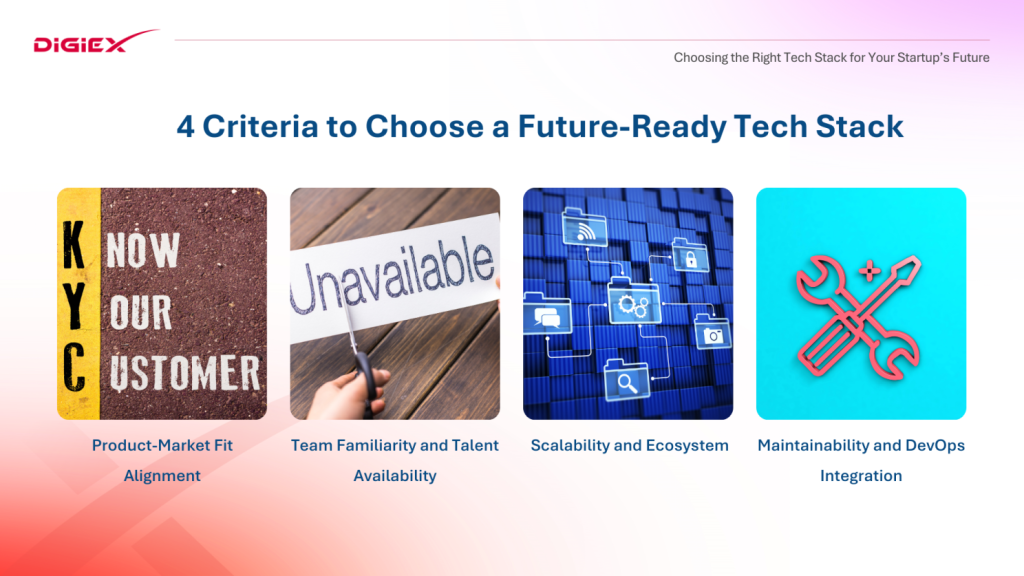
4 Criteria to Choose a Future-Ready Tech Stack
Choosing a tech stack is not about chasing trends; it is about aligning technology with your product vision, growth roadmap, and team dynamics. Here are four non-negotiable criteria every startup should evaluate.
1. Product-Market Fit Alignment
Does your stack match what you are building? For real-time applications, Node.js or Elixir might make more sense than traditional frameworks. If your product is API-heavy, consider scalable backend frameworks like Django or Express.js that simplify robust architecture.
2. Team Familiarity and Talent Availability
Use technology your team knows, or can easily hire for. There is no value in bleeding-edge tools if your engineers cannot build or maintain them efficiently. Consider the hiring market in your geography and your remote talent pool. MERN, for example, is popular partly because it leverages JavaScript across the stack, making it easy to find full-stack developers.
3. Scalability and Ecosystem
Your stack should grow with you. Look at community support, libraries, plugin ecosystems, and cloud-native capabilities. LAMP may be a legacy choice, but it is backed by decades of community resources and stability, ideal for content-driven platforms.
4. Maintainability and DevOps Integration
Think ahead: how easy is it to test, monitor, deploy, and debug? Django, for instance, is known for its clean code structure and built-in admin panel, which shortens development cycles and reduces tech debt.
Pro Tip: Favor maturity over novelty. Tools that have weathered time and are supported by vibrant communities will make your life easier when issues arise.
4 Tech Stacks to Consider for Your Startup
The stack you choose will shape your team, your velocity, and your future. Here are two popular go-to stacks and two lesser-known options that align with the criteria above.
| Stack | Best For | Talent Pool | Scalability | Maintainability |
| MERN (MongoDB, Express.js, React, Node.js) | Fast-paced product dev, rapid prototyping | Large, JS-wide | High | Moderate |
| LAMP (Linux, Apache, MySQL, PHP/Python) | Content-heavy platforms, tight budgets | Large, mature | Moderate | High, decades of tooling |
| Django + React | Complex business logic, clean architecture | Moderate | High | High, built-in admin & structure |
| Elixir + Phoenix | Real-time, high-concurrency systems | Small, specialized | Very high, fault-tolerant | Moderate |
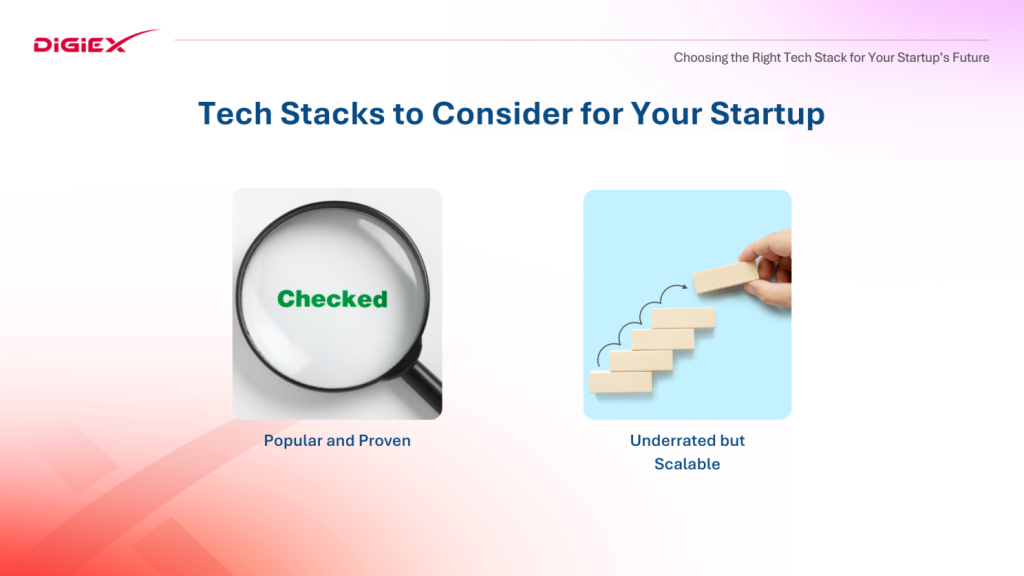
Popular and Proven
MERN is ideal for fast-paced product development and rapid prototyping. It aligns well with team familiarity, scalability, and DevOps readiness, especially for startups that want full JavaScript across the stack and access to a large developer pool.
LAMP is reliable and cost-effective. A strong match for long-term maintainability and ecosystem maturity, particularly for startups building content-heavy platforms or launching quickly on a tight budget.
Underrated but Scalable
Django + React combines Python’s robust backend with a modern JavaScript frontend. This stack scores high on product-market alignment and DevOps integration, especially for startups building complex business logic with clean documentation and scalability in mind.
Elixir + Phoenix is a powerful choice for real-time applications and high-concurrency systems. While the talent pool is smaller, this stack offers standout performance, fault tolerance, and scalability, excellent for fintech, gaming, or messaging startups aiming to future-proof from day one.
Pro Tip: When evaluating a stack, look at real-world case studies, not just GitHub stars. What are startups like yours using to grow fast without rewriting their codebase after eighteen months?
Do Not Let Your Stack Hold You Back
The tech stack you choose today will either accelerate or limit your startup’s growth tomorrow. While the options are many, the decision is strategic and often irreversible without major rework.
This is why the most successful founders do not just rely on intuition. They seek expert guidance to align technical choices with business goals, team capacity, and long-term vision.
Contact DigiEx Group to evaluate your current architecture, weigh your options, and plan for growth with a tech stack built for your future.
Your next sprint could define your next milestone. Let us help ensure your tools can take you there.